Saturday, December 7, 2013

QUEST FOR KNOWLEDGE.

THE PATH LEADING TO KNOWLEDGE
 If I  had to describe a University, I would  draw my answer from its ancient designation of a "Studium Generale", or “School of Universal Learning.” This description implies the assemblage of strangers from all parts of the world in one spot  with teachers and students for every department of knowledge.  
We Indians have always been very proud and vocal about our heritage, our parampara, our knowledge, our ancient glory, wisdom, development of art, science, niti and advancement in astronomy, maths, dance and music. Where did we learn it and where did we teach it? 
This question took me to our great centers of learning of which the most well  known  are Takshashila, Nalanda and Vikramshila. Takshashila, now in Pakistan was the oldest. A few  famous teachers of Takshashila were Chanakya, Vishnu Sharma who wrote the Pancha Tantra, Charaka the Physician, Panini the Grammar Exponent and Jeevaka, the Physician of the Buddha. A famous alumni was Chandragupta Maurya, grand father of Asoka the Great. Takshashila was in existence since eighth century BCE, and continued to attract students from around the old world until the destruction of the University in the 5th century by the Huns.Students came here from Babylon, Greece, Syria, Arabia, Phoenicia, China, Magadha, Kashi and Koshala. In spite of the long and arduous journey they had to undergo,  the excellence of the learned teachers  brought students from all over. The teachers were recognized as authorities in their respective subjects.There were about 68 different streams of discipline here. There were about 10500 students studying here.This University's primary concern was not with elementary, but higher education. Generally, a student entered Takshashila at the age of sixteen. 
When Alexander attacked India in the 4th Century BC, he took back with him a number of scholars from here. Is it therefore surprising that a lot of myths, and stories are quite similar in Greece, Syria and India?

Vikramshila is the lesser known University, which is located in Bihar near Bhagalpur. It came into existence after the Nalanda University was at its decline.

SARIPUTTA'S STUPA AT NALANDA
Nalanda is known to almost all of us. It is in Bihar, close to Rajgrih and Patna. This University existed from 5th Century AD to 1197 AD. In the first 300 years it flourished with liberal cultural traditions but from 9th century onwards the decline set in as Tantricism became more pronounced.  Yijing( 673- 695AD) a Chinese Buddhist scholar says that when he was at Nalanda there were 300 rooms and 8 colleges, and matters of discussion and administration required an assembly and consensus by all at the assembly as also of the resident monks, who were not at the Assembly. 
THE ENTRANCE IS BEHIND ME
My journey on the path traversed by The Great Buddha took me from  Rajgrih to Nalanda. The gate to this center of learning, education and   wisdom was quite small. But as soon as I went inside, it was like entering a different world, where there was no noise, no sound, nothing but bricks, and ruins which spoke of the amazing brilliance of this place. It was as if I had entered from a tunnel into an amazing space filled with light . 


ROOMS


There were ruins of monasteries after monasteries on one side, and then there were temples and then there were stupas.
Admissions to institutes of learning has always been tough. Ask the parents of a toddler today, and they will tell you that the toddler goes to a prep school so that subsequently the child gets admitted to a good school. So from time immemorial admissions to institutes of learning has been tough. Is it any wonder then that getting admission to the Nalanda University was really tough? Do you know, according to folklore  who asked the first questions for the admission interview? It was the dwarpal or the Doorman. So much wisdom oozed out from the place that even the gatekeeper could interview a new student to judge if the student was capable of studying at Nalanda. Religion, logic, metaphysics and a lot more disciplines were taught here. Students came from Korea, Japan,Iran, Indonesia and China, besides of course Magadh, Kosala and Kashi.
TWO BEDS & A BOOK SHELF
I allowed my imagination to fly as I entered the Monastery.Each Monastery is a complete unit by itself. There are rooms with a built in bed and a shelf for keeping books. Two students would share a room. There is a kitchen, a well, and a place for the teacher to sit and give his discourse. There is a drainage system, where the drain becomes deeper as it goes towards the pit.
TEACHING SPACE
I imagined a class going on where the students were eager to learn. There would be no forced learning, it was your own desire to learn. Fees were not charged. The rulers of the area made it mandatory for some villages to provide the University with funds to carry on with the teaching unhindered, so education was state sponsored.
Our famous tourists and scholars from China, the great Hieun Tsang and Fa Hein have written great accounts of the University.
THE GIANT WILD GOOSE PAGODA AT XIAN, CHINA
Hieun Tsang travelled to India in the seventh century AD to study at Nalanda. He took back a lot of books with him and in Xian in China, the Tang dynasty King gave him land to build a Library in 652 AD, which for some strange reason is called "The Giant Wild Goose Pagoda". I saw this pagoda which one cannot enter now, but the surroundings are maintained very beautifully.
THE MOUNDS & THE RUINS
Nalanda had a very huge campus. Even today the surrounding villages are  built over  mounds, which if  dug will reveal more monasteries and Temples.
The Library at Nalanda University was very famous and had a huge collection of books.
BURNT BRICKS
In the 13th century when the Khaljis set out to destroy everything which was not about their religion, they burnt this whole university down. It is said that the Library burnt for three whole months. Even today after almost  900 years, one can see some burnt brick walls, and feel sad about this misjudged act of arson.
A BENCH & SERENITY
The gardens and lawns around the ruins are maintained immaculately. One can sit under a tree and feel the monks moving about, and  hear the discussions, the theories and the debates going on. The air over here must be wise, the trees must be swishing thoughts when the wind blows, the walls if only they could communicate would tell us more tales than one.
Nalanda is where the stupa of Buddha's Shishya Sariputta exists.
SEEK & YOU WILL RECEIVE


Nalanda is where perhaps knowledge  spread, got wings and then got burnt down, ending our quest for learning, free thinking, radicle thoughts, where it was all about learning for betterment and improvement of the self. There were no certificates awarded, there were no jobs guaranteed, there was no money at the end of the knowledge gates.  It was emancipation, enlightenment, and development of the self.
 Learning was at its best, the thirst and quest for knowledge was the essence of existence. 
Could there be anything better than this insatiable hunger for knowledge?
ROOMS WITH PLACE FOR LAMP
As the Wise Buddha said, "Atta deep bhava", or in wisdom be a lamp unto yourself. He also said, "Do not blindly believe what others say, even if it is said by the Buddha. See for yourself what brings contentment, clarity and peace, that is the path for you to follow".
Knowledge, freedom from blind faith and eventual enlightenment can only be achieved when we open our minds, question, discuss and then get convinced.  Quest for knowledge can only be quenched by questioning. 

Saturday, November 23, 2013

RAJGRIH to RAJGIR- CAPITAL OF MAGADH EMPIRE.


THE BUDDHA AT SWARNA BHANDAR

 India has been a land through which great rivers flowed. These rivers originated from the Himalayas and brought prosperity to the land through which they travelled. Great settlements came around these rivers, over time a system evolved,  and customs and traditions started getting formulated.

JIVIKA'S MONASTERY
In the 6th century BC, about 2700 years ago, there were some parts of India which were very prosperous. These were located on the foothills of the Himalayas, near the banks of the river Ganga and its tributaries. There were about 16 Janapadas at that time of which the great Magadh Empire had its capital at Rajgrih and was ruled then by Bimbisara, The Kosala Kingdom was at Shrawasti, and it was ruled by Prasenjit, The Shakyas ruled in Kapilvastu and its King was Shuddhodhan, the Licchavis ruled in Vaishali, the Mallas ruled in Kushinagar, Koliyas ruled in Ramagrama,. These were all small states where a ganarajya or janapada  existed, with a King who was advised by  eminent advisors.
The Magadh Empire was said to be a very powerful Empire and  during a much earlier era, this place is said to have been ruled by Jarasandha, who was the father- in- law of Kansa of Mathura.
Our hero, Prince Sidhhartha at the age of 29, left his palace at Kapilvastu( located in Nepal and also north UP-Piprahwa) and went towards the South seeking knowledge.
He arrived at Rajgrih and became the disciple of Alara Kalam and  Udaka Ramputta  and learnt yogic meditation from them. Bimbisar the King asked Siddharta to stay at Rajgrih, but the seeker of knowledge moved on further South and after six years attained enlightenment  at Gaya. He then proceeded to Sarnath and preached his first sermon to five disciples, after which he proceeded to Rajgrih to locate his first gurus, but  found that both Alara Kalam and Udaka Ramputta had since died.
Bimbisar  accepted the teachings of Buddha, became a Buddhist and requested Buddha  to stay at Rajgrih.
VENUVAN TODAY
The Venuvan or Bamboo Grove was given to the Buddha for his stay as well as for the stay of his followers. Buddha met two of his ardent followers Sariputta  and Moggalayan at Rajgrih, 
Buddha was a person with a mission, who wanted to spread his teachings far and wide and so he did not stay at one place for too long. During his lifetime he stayed in Rajgrih altogether for twelve years. In those days the Teacher would stay put in one place during the four months of the  rainy season, and that stay was called the "varshavaas".
Rajgrih is a beautiful place and like Rome, is surrounded by seven hills. There was peace, plenty and prosperity in this area. First came Buddha and then it is said,Mahavira too spent 14 years at Rajgrih.
SHANKH LIPI
As we entered Rajgrih in the 21st century, we found the familiar blue board of the Archeological Survey of India(ASI) on the Highway. 

ARE THESE CHARIOT WHEEL GROOVES?
There was a small enclosure, where we found grooves on the stone. which were like tyre tracks of a vehicle. We were told that these were the grooves caused by the speed of the rath of Krishna, when he came to wage war with Jarasandha during Mahabharata time. In fact Krishna fought with Jarasandha 17 times and in the 18th attack he left the war grounds, that in fact is the reason why Krishna  is also called Ranchhod. There was also some writing on the stone in a script which is called the Shankh lipi. This writing has not yet been deciphered, therefore we could not make out what had been written there.
BIMBISAR'S JAIL
Our journey then took us back to the 6th century BC, and we saw the walls of the jail of Bimbisar.  Ajatshatru the son of Bimbisar wanted to expand his kingdom, and so he imprisoned his father, wrested power from him  and went forth in his quest for expansion and relocated his capital to Pataliputra. From this jail  Bimbisar could look up and see Buddha climbing the hill and preaching to his disciples at Gridhrakoot hill. 
GRIDHRAKUTA HILL FROM WHERE BUDDHA PREACHED
There are steps which takes one up to this spot, where Buddha sat, meditated and preached. A little towards the West of this spot is the Shanti Stupa made by the Japanese.  
CHAIR LIFT & BAMBOO GROVES
There is a Chair lift ropeway which takes us up to the Stupa. The climb is steep, the view is beautiful and one is reminded of the movie "Johny Mera Naam" where Dev Anand and Hema Malini travel by the chair lift , and sing a song,"Oh mere raja, khafa na hona, der se aayi, majboori thi phir bhi maine wada to nibhaya!
THE JAPANESE SHANTI STUPA
The ride on the chair lift costs Rs. 60/- and is worth it, the stupa is grand and there is a temple of the Buddha at the top. 
An identical stupa in white with statues of Buddha on the four sides is at the  Millenium Indraprastha Park in East Delhi, and I have also seen an identical one in the Battersea Park at London.
SWARNA BHANDAR OF BIMBISAR
There is an interesting cave at Rajgrih. It is called the "Swarn Bhandar" of Bimbisara. 
THE DOOR TO SWARN BHANDAR
The outline of a door is carved on the rock and there is some writing in Shankh lipi, which is said to be the mantra to open the door. This cave is supposed to contain treasures of Bimbisar's empire.
CARVINGS OF THE BUDDHA'S STATUE
There are nice carvings of the Buddha on the walls, but they were defaced by the Khaljis when they attacked the University of Nalanda as well as Rajgrih, in the 13th CenturyAD. Our earliest international tourists, devotees and learners were Fa Hian and Hiuen Tsang who came from China in the 5th and 7th Century AD respectively. Both  of them have written extensively about Rajgrih in their books.
The First Buddhist Council(sangiti) was held in the Saptaparni cave, near the Swarn Bhandar  soon after the death of Buddha, under the leadership of Maha Kassapa, along with Upali & Anand. Rules and tenets of Buddhism(vinaya & dhamma) were formulated in this Council and written down for the first time. It is said that the famous physician Jivika also lived in Rajgrih. He had treated Buddha when Buddha was attacked by his cousin Devdutt. There was a Jivaka-mara-vana monastery here.

HILLS
Rajgrih which has a stupa made by Ajatshatru, and a few other places to see, beside the hot sulphur springs, is now a very small town. It is sad to see that the cradle of the great Magadh Empire has now become just a small tourist town, where tongas are the main mode of transport. 
A TONGA.
It is of course a very pleasant ride on the tonga from one site to another, as the hooves of the horse make a rhythmic trot, the tongawalla narrates his tale about Rajgrih, the majesty of the hills surrounding Rajgrih are visible, and the thought that Buddha spent so many varshavaas months here teaching, preaching and enlightening the people of this land, envelopes you. The feeling sinks in and one gets transported into a time which existed thousands of years ago. The hills, the bamboo groves, the ruins are mute spectators of time having taken its toll. Buddha looked at those hills and enjoyed the fresh air, as I do now!

SURROUNDED BY HILLS
The mornings are beautiful, the place is peaceful, the air is pure, bamboo groves are a plenty, Rajgrih has become Rajgir and much time has elapsed since Ajatshatru moved on to Pataliputra  to spread the Magadh empire and make it one of the most powerful empires of Indian History. Perhaps Rajgrih was too peaceful and calm, and could not contain the ambitions of a restless young King.  
Buddha who convinced people through reason and persuasion has said that there are 3 Universal Truths of which the first is "Aniccha" or impermanence, which means that the world is constantly changing, nothing is permanent, life itself is mortal. 

Wednesday, November 13, 2013

BODHGAYA.

FRONT PORTION OF TEMPLE MADE BY ASOKA.
Siddhartha, Gautama THE Buddha (563 BC - 483 BC) has always been a historical figure who fascinated me since I was a small girl. I read about him in my History book and was quite intrigued to know that he was kept away from the sight of old age, illness and death, as they were reasons for sorrow and  it had been predicted that he would leave the splendors of the palace if he experienced  sorrow.  It was similar to the story of  Sleeping Beauty, a fairy tale read by me around the same time. A bad fairy had cursed that  the princess would be pricked by a spindle and would fall asleep for a 100 years, so spinning wheels were banned in the kingdom by  the King.
THE GARDEN AT BODHGAYA TEMPLE
My love for Fairy tales made me visualize the story of Siddhartha also as a fairy tale until I realized that Siddhartha actually existed in real life. It was a real story and not a tale at all.
Living in Bihar in my childhood, I had visited Bodhgaya, Rajgir, Nalanda and Patna a couple of times.
THE BUDDHA AT THE MAIN TEMPLE
I knew the places, yet recently when an opportunity came my way I quickly planned a trip down the path traversed by Siddhartha Gautam. Our journeys were separated by more than 2500 years. I was excited beyond words. I desired to go to all the places visited by Prince Siddhartha and by Buddha after attaining enlightenment.
I planned my trip by convenience and not as per the route of The Buddha.
BODHGAYA TEMPLE
My journey started from Bodhgaya. The place where Siddhartha became THE Buddha.
Gaya as almost everyone knows is a very religious place or a teerth sthal for Hindus. This town is situated on the banks of the river Phalgu. The old and more beautiful name of the river is Niranjana.
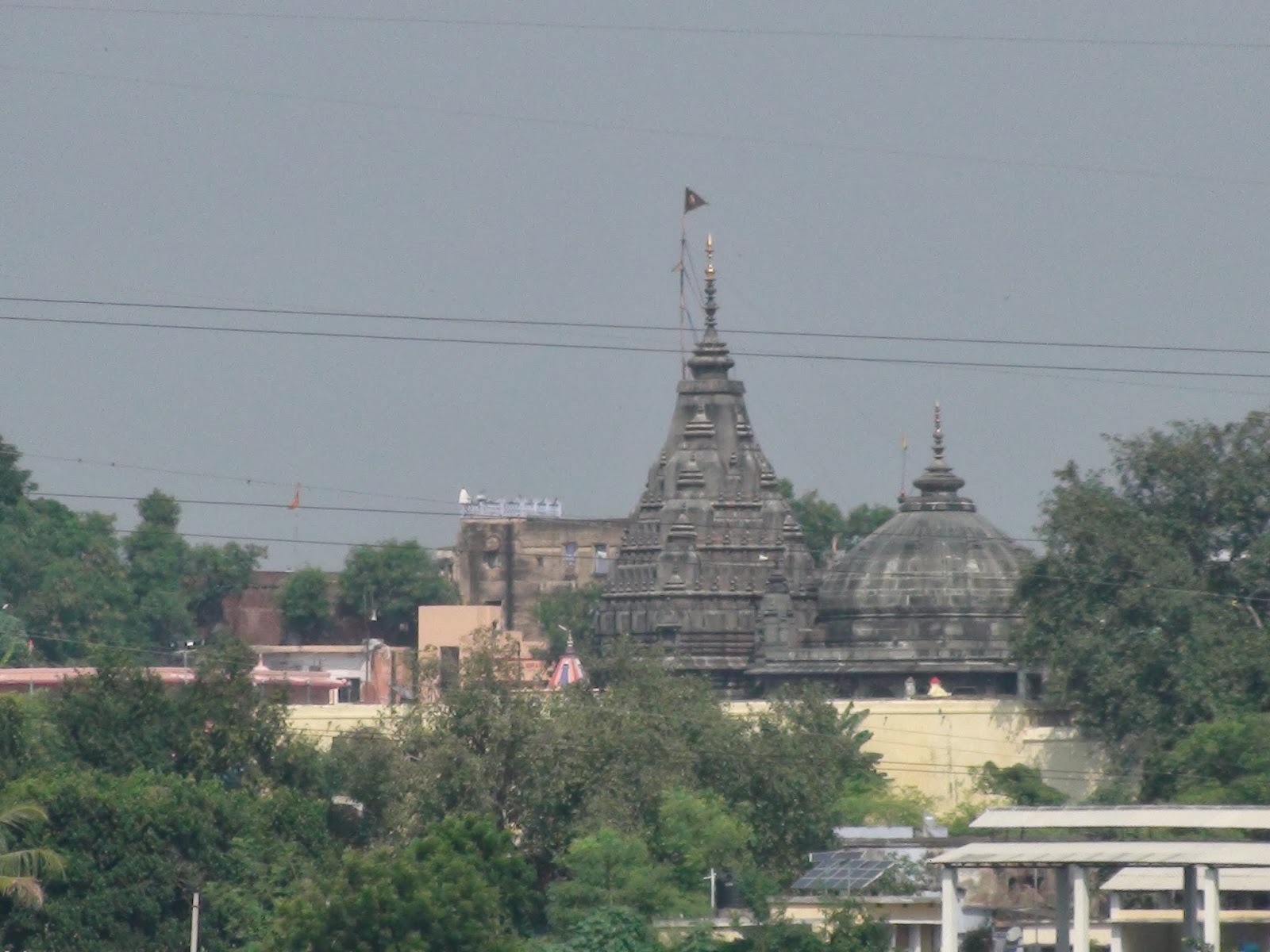
VISHNUPAD TEMPLE AT GAYA
Gaya as we understand in Hindi means"gone."Gaya is the place for salvation of all Hindus. The last rites of a person are performed by his family to enable him to get salvation or freedom from the eternal cycle of life and death. It is understood that when the last rites or Shradh is conducted in Gaya, the soul rests in peace forever. Shradh at Gaya is said to absolve all the sins of all the ancestors of the person performing the Shradh. According to the Ramayana, Ram accompanied by Sita had also gone to Gaya to perform Shradh of his ancestors.
BODHGAYA ACROSS NIRANJANA RIVER FROM SUJATA'S STUPA
It therefore was quite interesting to realize  that Siddhartha freed himself from the bondages of life at Gaya, close to the banks of the River Phalgu then called Niranjana. He absolved himself from all the various desires and feelings that a person has which can lead him into temptation. He took on the mantle of a teacher whose only mission in life was to teach people the right way to live.
They say he got enlightened, he got gyan, he became the Buddha, sitting under the Peepal tree.
I don't think it is as simple as that. His enlightenment evolved. It was realization, it was a process that took its own time

THE PHALGU & PILGRIMS PERFORMING SHRADH
After leaving Kapilvastu, the city where the Shakyas headed by Shudhodhan his father ruled, Siddhartha wandered from place to place for six years. His first teachers were Alara Kalam, and Udaka Ramputta who taught him yogic meditation. They lived in Rajgrih, which was the capital of Magadh and was ruled by King Bimbisar. Having learnt what they taught him, he moved onwards on his quest. He  joined a group of five ascetics led by Kaundinya and tried to find enlightenment through deprivation of worldly goods, and practicing self mortification. He tried penance, he starved himself, existed on roots and did all the things possible to torture his body to attain knowledge and salvation.
THE TREE 
One day as he sat under the Peepal tree meditating for almost 49 days, a lady named Sujata who lived in  Village Senani near Uruvela( Old name of Gaya) across the river Niranjana came to offer Kheer to the Vriksh Devata. Siddhartha who had been fasting, ate the offered Kheer and then they say enlightenment dawned upon him. He  realized that extreme asceticism did not work. He discovered the Middle path, which is called the "Ashtanga Marg" or the eight fold path. The five other ascetics had meanwhile left him as they thought that Siddhartha had abandoned his search and had become undisciplined, because he partook of the kheer. 
SUJATA'S STUPA AT SENANI
Siddhartha discovered a path of moderation away from extreme self indulgence or self mortification. After becoming enlightened,Buddha looked for the five ascetics who had left him. They were in Sarnath near Kashi (Varanasi). He found them, shared his thoughts with them and that was the place where his first Sermon took place and those five became his first disciples.
STONE RAILING
My journey to Bodhgaya took me straight to the Temple where the Bodhi Vriksh(tree) is located. The original tree was destroyed long ago but the present one planted at the same spot is a sapling of the original tree. A sapling of the original tree was sent to Srilanka(then called Tamraparni)in 288 BCE by Emperor Asoka( 304-232 BCE), and so now what we have in more places than one are all saplings from the tree at Srilanka. 
METAL RAILING
The tree is enclosed by a metal railing and is kept safe. 
Emperor Asoka had built a stone railing all around the tree. That  railing is now preserved in the Archeological Museum at Bodhgaya. A replica has since been erected around the tree.
 
SITTING SPACE
All around the temple and the tree the courtyard is cemented and there is a marble parapet all around. One can sit down comfortably and allow peace to descend upon us.
What I felt under the shade of this huge magnificent tree cannot be really described by me.  There were a lot of people, and yet there was no noise, no dust, no dirt, no disturbance. Everyone was sitting in peace. I didn't want to get up from there. It was a surreal feeling. It had a very soothing and calming effect. I felt the centuries disappear and all the commotion, confusion, pollution, stress of my daily life seemed like a thing of some imaginary world. Peace, compassion, calm, and a feeling of kindness, camaraderie and co existence enveloped everyone. There was no jostling or pushing, everyone had enough space under the all encompassing tree.
80' STATUE
After leaving the temple we visited the tallest sitting Buddha statue( 80') and some other Buddha temples constructed by other countries in the neighbourhood. But the feeling that I got at the original site could not be replicated anywhere else.I also visited the Museum where I could see the original Asoka railings. 
ASOKA'S RAILING
Bodhgaya is easily reachable. There is an airport at Gaya and the major trains going towards Kolkata or Ranchi also stop at Gaya. One is not allowed to take mobile phones inside the Temple. There are lockers outside the temple where one can deposit the phones and any other possession that one does not want to carry inside. There are no charges for this and are secure, as the locker key is given to us. For taking the video camera inside one has to pay Rs. 250. 
THE ENTRANCE TO THE TEMPLE
The next day we were to leave for Rajgir. I couldn't  leave without taking another look at the Bodhi tree. What I saw was a visual treat. There were about 200 Srilankan pilgrims at the temple. They had decorated the entire boundary of the Temple with the Buddhist five colored flag. They were now in the process of adorning the walls with marigold garlands. All the 200 people were in white clothes and walked quietly around the temple in a procession. They then sat down and meditated quietly.
It was a very peaceful & beautiful sight of total devotion.
Sitting under the tree I also dwelt on a lot of thoughts. Buddha advised us to follow the Middle path where  everything is in moderation. "The Ashtang Marg" briefly is Right belief, right thought, right speech, right action,right livelihood,right effort, right mindfulness, right meditation. 
I felt that in the real world we give importance to so many feelings which are really very un-important in hind sight. We allow anger, hurt, stress, guilt, rat race, competition, envy to rule our lives. Does it really get us anywhere? Perhaps following the eight fold path shown by Buddha would be a path which would make life simpler and happier. Sounds very simple, doesn't it? But then Buddhism was never meant to be a religion. The Teacher only taught us the correct way of living.
"WITH FIRM RESOLVE, GUARD YOUR OWN MIND"-BUDDHA.

Sunday, November 3, 2013

A TRAIN JOURNEY THAT TEACHES


RANCHI JUNCTION

As we travelled by Rajdhani Express from New Delhi to Ranchi recently, I recalled all those journeys taken ages ago by a slow train from Old Delhi railway station.  The train would either be the Delhi Patna express which used to have one bogey attached going up to Ranchi or the Kalka Mail. I would normally travel by the Delhi Patna Express in the bogey meant for Ranchi, which would get attached to the Patna Ranchi Express perhaps at Gomoh. It used to be a slow train journey, with the train halting ever so often. I would read and sleep and sleep and read throughout the journey.
EVERYONE AT THE DOOR
This time the journey was for about seventeen hours and the train would stop only for a couple of moments at chosen stations. There was no open window, there was no smoke billowing from the steam engine, one could not stick ones head out of the window to look out at the end of the train when there was a large turning on the track. One missed all the people throwing coins into the Holy Ganges or for that matter any river over which our train went. Those were such fascinating train journeys when the train sang to us in rhythm. The Bengalis used to say the train says, "Didi koto, dada koto?" Some would say that the train sang,"chhuk, chhuk, chhuk, chhuk,oooooooooo!"
It was a soothing continuous sound which easily lulled all of us to sleep.
This time the usual musical sound was missing. The familiar "chai, chai, chai, chai, chai bolo chai", couldn't be heard. The taste of kulhad wali chai was a thing of the past.
BOKARO STEEL PLANT
In those days I would love to read the Bradshaw( Railway Time table) and wait to see the next tiny station pass by, or the next bigger station where the train would stop, and give me a chance to see the little bit of cultural change as we moved on eastward. There was the compulsory sindoor on the head, the very colorful sarees, whole families sitting crowded together on the platform. Rustic India with fields and fields of Dhaan, sugar cane, wheat would go past. It looked beautiful and plentiful and reassuring. All was well with the world, peace prevailed, and everyone went on with their jobs.


THE FARMERS & THEIR FIELDS
There would be plenty of women singing and working in the fields, men would be with their bullocks and ploughs and keep ploughing the field.
I remember those railway crossings with traffic on both sides of the track. Bullock carts, motor cycles, jeeps and a few buses. Everyone looked eagerly at the train, as if they would spot a familiar face going past in the train. There are these crossings still, but there is a look of impatience on the faces of those waiting for the train to pass. Everyone is in a hurry. There is now no time left to just stand and stare. 

THROUGH THE GLASS.

In the twenty first century, we have got cocooned inside air conditioned coaches. We are treated to food and more food throughout the journey. Clean sheet, pillow, a towel are given to us. An attendant is available to look after our comfort. Those days of traveling with a holdall have gone forever. Times have changed. A train journey is no longer filled with adventure, surprises and fear of someone entering the bogey and sitting on our allotted seat. Fear of petty thieves running away with our luggage once you have fallen asleep. 
When I was a child and travelled with my parents the 1st class was a compartment by itself. It had a seat like a sofa, there were berths and a toilet all to yourself. The door handles used to be quite heavy and  if you were a family of four one could lock it from inside and travel safe. The dining car was a place where one would go for meals. Meals were served with proper crockery and cutlery. The food was delicious. Specially the cutlets that they served.
THE GREAT GANGA
Times they are a changing, they are more comfortable, but memories of childhood and youth are more romantic. A journey by train was not just a journey to reach a destination. It was all about enjoying a full two or three days of looking at nature, the varied culture, the numerous rivers with their gigantic bridges, the chaiwallah, A H Wheeler book stall, kiosks selling food stuff where poori bhaji was the most prominent and popular preparation. It was actually a lesson in Geography.
I am not grumbling, I am only saying that travel has become more comfortable and safe, all that we have  lost is our touch with people,  our tolerance, adjustment, and sharing space. We are fearful of strangers. We have lost the art of trust. The way the people of the world have changed with misplaced priorities that one has to look for security and safety first and foremost. "Trust" has gone into the archives. 
NOT TO BE MISSED
Besides that we have become so busy that we want time to pass faster. We just want to reach our destination, without capturing the scene as it passes, without imbibing the changing scenario of people, or the dresses that they wear, or learn about the Geography of the place as India reveals itself to us.
The human touch is slowly disappearing. I know we can see, learn know everything through Google, yet what one saw and learnt with ones own eyes in direct contact with the visuals changing in front of us, is unforgettable.


Monday, October 14, 2013

A BLIND SPOT IN HISTORY.


PURANA QILA
Would it surprise you if I told you that Sher Shah Suri(SSS) or Sher Afghan ruled over a large part of India only for five years(1540-1545)? The kind of lasting legacies that he has left on administrative reforms make me marvel at his vision and far sightedness.The era of SSS is quite unsung and lesser known than the other rulers of Delhi.
Most of us would be knowing that the Grand Trunk Road(G T Road) was built by Sher Shah Suri. Roads are the life line of a nation. It makes administration easier. Suri was from Sasaram in Bihar and after defeating Humayun he ruled from Delhi, so he knew the importance of communication network, movement of news as well as troops.  In History such a massive road was built during Ashoka's rule from 304 -232 BC, as his empire stretched from Afghanistan to Bangladesh and from Central Asia to South India. The GT Road or "Sadak-e -Azam"  was built  keeping  the convenience of the people moving on the road in mind.There was a kos minar built after every two miles and a sarai(inn) built after every three miles of the road. Trees were planted along this road for shade. SSS also introduced the dak system. He appointed harkaras who would carry post from one place to another. This dak was not only for administration but the convenience was also extended to traders  for business communication. Harkaras were runners who would go up to the next post and from the next post the next man would take the dak and run onwards, like a relay race. The harkaras carried a danda(stick) with  ghunghroos or bells attached to it so that their approach could be heard by the next man in the relay race, and he could move onward  without any pause. 
There were 1700 dak chowkees with 3400 harkaras in those days running on 3000 kms of roads connecting the whole country. Later horses were used for transportation of the dak. There would be a chowkidar to attend to the horses of the harkaras  and oxen of travellers at the sarai, which doubled up as the dak chowkee. A daroga was in charge of this sarai and there were two tarikh- navis who would record the arrival and despatch of the dak.
CHAITYA LIKE DESIGN
Another major reform that SSS devised was replacing the system of province with sarkar, pargana and village. The empire was divided into 47 provinces called sarkar, managed by (1)Munsif- e- munsifan(Chief of Justice) and (2) Shiqdar- e- shiqdaram( Military chief).
Each Sarkar was divided into smaller districts called Pargana. The pargana was managed by
(1)Munsif (judicial officer),
(2) Shiqdar(administrative officer),
(3) Amin(revenue officer),
(4) Patwari(keeper of land revenue record),

Then there were villages which had the
(1) Choudhry( land holder),
(2) Muqaddam(village headman)
(3) Karkun(accountant),
(4) Mushrif(holder of trust),
(5)  Khazanchi(treasurer).
There would be a Fotedar who maintained property records in Persian and Hindi. There would be a Kanoongo who supervised these records. So akin to clerical and supervising staff of today!
Interestingly these officials were transferred after every two or three years to prevent misuse of office. I simply liked the designations of the Officials, so have given the details. Interesting to note that now one does come across people having these surnames.
It may surprise you to know that SSS introduced the standardized  Rupia. Rupia was a generic term used for silver coin of any denomination since the Magadha empire.  During the rule of Chandrgupta Maurya (340-290 BCE) the silver coin was called Rupya-rupa. SSS standardised the Rupia to be a silver coin weighing 178 grams. A gold coin was a Mohur weighing 169 grains and a copper coin was called daam. We now use the word daam to mean price.
REPAIR OF OUTER GATE

 The Old Fort or Purana Qila was built by Humayun in 1533. It was basically a fort for accommodating the troops. There were not many buildings in the Fort. Archeological Survey of India(ASI) did a lot of excavations in this fort as it was believed that this was the place where Indraprastha of Mahabharat times was located. After the excavations it was found that the history of human inhabitation at this place only goes back to the 2nd century BC. The Mahabharat time is said to have been somewhere around 800 BC.Therefore one can safely assume that Indraprastha of ancient times was surely not located here. Just for reference sake the Indus Valley Civilization is said to have existed between  (3600-1200 BC)  
SHER MANDAL-OBSERVATORY & LIBRARY.
Humayun could not live in peace for long as he was defeated by Sher Shah Suri and fled to Afghanistan and then Iran. Humayun sought the help of the Iranians to regain his empire from the Afghan SSS. To gain  support from the Iranians Humayun  had to convert from Sunni to Shia Islam. Humayun has been described as a forgiving person by his biographer Gulbadan, who was also his sister. He repeatedly forgave his brothers who tried to dethrone him or conspired against him. He was known to have a lot of faith on astrology, the occult and astronomy.  He was very superstitious and would not set foot inside a house with his left foot. 
He re-organized the administration upon mystically determined principles. He divided the public offices into four distinct groups, for the four elements. The department of Earth held charge of Agriculture and the agricultural sciences, Fire pertained to the Military, Water, the department of the Canals and waterways; and Air seemed to have responsibility for everything else. 
He disdained warfare and after winning a war would spend months together indulging himself at the captured city. He was out of the Old Fort for 15 years wandering from place to place, and after his last battle with SSS with the help of the Iranians, he lived at the Purana Qila for 5 years before tumbling to his death. In 1556 he fell from the steps of his Library when the Muezzin called out for the evening prayers. There is also a thought that he was star gazing and missed the stair, or perhaps he was under the influence of Opium and didn't know where he was going. 'He tumbled in life and finally tumbled out of it too' is how his life has been described. On October 1556 the last Hindu King of Delhi,Hemu won the throne of Delhi and  had his Rajya Abhishek(coronation) at the Old Fort. In the second battle of Panipat Hemu lost to the Mughals and in  November 1556, his torso was hung outside the walls of the Fort.
The walls of the Fort are 18 metres high and stretch across 2 km. 
JHAROKA
The Fort has three main gates, the Bada Darwaza facing the West, the Humayun gate towards the South and the Talaqi Gate towards the North . The gates are beautiful with Jharokhas and Chatris. There were tiles on the walls which were blue with beautiful work on it. These tiles were most probably imported from Central Asia.
The walls of this fort are straight unlike the Tughlaqabad Fort where the walls are slanting.

QILA E KUHNA-MOSQUE

The Qila e Kuhna is a Mosque built by SSS. The workmanship is very ornate and the carvings are beautiful. One can see the use of the lotus, lotus buds as well as the Kalash and Chaitya like designs of Ajanta on the pillars , arch and the dome.

KALASH ON RIGHT PILLAR

The only other structure in this Fort is the Sher Mandal which was an Observatory as well as a Library for Humayun.
KHAIR UL MANZIL MOSQUE

Opposite the Fort across the Mathura Road stands another lonely building. Yes, lonely, as it stands alone. This is the Khair ul manzil a mosque built by Maham Anga, Akbar's wet nurse. 
HOSTEL & MADRASA
There was a Madrasa attached to this Mosque as well as rooms where students could stay. It is said that once while Akbar was returning from Nizammudin dargah, an arrow was shot at him from inside this Mosque, which missed the mark. 

THE DOME
The construction of the dome has always been an enigma for me. At the Qila e Kuhna mosque this mystery was clearly unfolded to me. In the corners of a square room, four arches are made , on top of it eight arches are made, then sixteen, and so on until a circle is formed over which the dome is constructed.
After partition Muslims of Delhi and neighbouring states who wanted to go to Pakistan stayed at the Old Fort waiting for their train to Pakistan.
The Nawab of Rampur is said to have donated blankets to people only from Rampur State staying at this camp.
The Old Fort, quite barren and  forlorn actually looks old. It's a place which was never really inhabited. No ruler could enjoy living and ruling from this Fort. They had to flee and seek refuge elsewhere, or died violent deaths like Humayun's fall from the steps and hitting his head or Hemu dying at Panipat in the war, barely one month after his coronation. 
Although I believe that Indraprastha did not exist here, yet if it did then,  true to its nature the fort did not allow the Pandavs too a life of peace and happiness. 
The Old Fort is a place which was inhabited continuously since the 2nd Century BC, but now only animals live within the Fort as the Delhi Zoo is now located here. There is a Sound and Light programme too organized in the evening when one can visualize  & hear the History of Delhi. There is a museum inside the wall of the fort where one can see the material that was excavated from this area.
Everytime I pass the Purana Qila, I feel like visiting it and seeing why this fort refused to offer safety, peace and happiness to its inhabitants.